Black lung rates among Appalachian coal miners reach highest level in nearly 50 years
A federal study found that one in three long-time underground coal miners in Kentucky, Virginia and West Virginia showed signs of black lung disease on X-rays taken in the last five years. The federal rule meant to cut miners' exposure to silica dust is on hold.
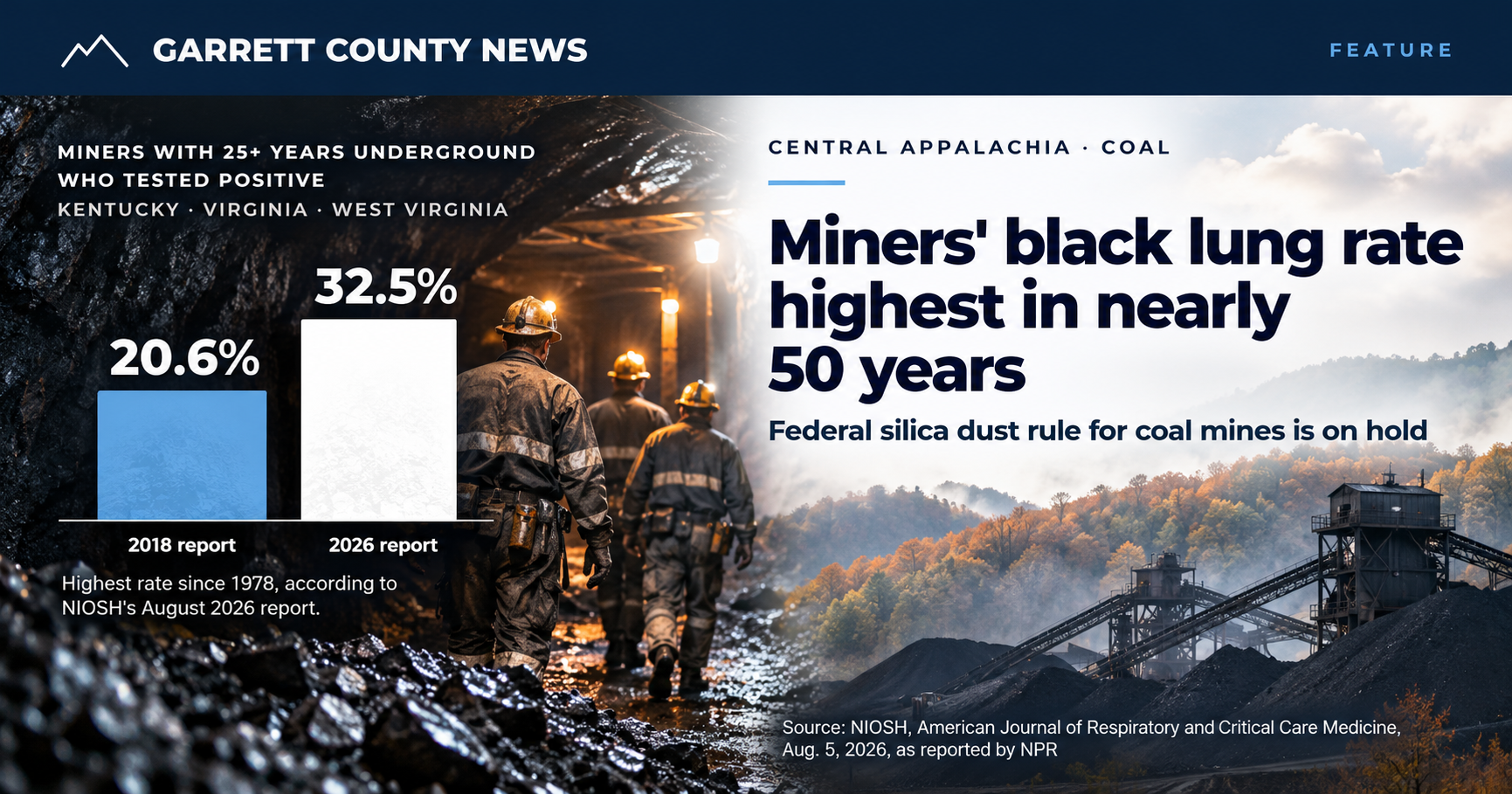
Black lung disease among veteran coal miners in central Appalachia is at its highest rate in nearly 50 years, according to a study by the National Institute for Occupational Safety and Health (NIOSH).
The study was published Aug. 5, 2026, as a peer-reviewed research letter in the American Journal of Respiratory and Critical Care Medicine, under the title "Coal Workers' Pneumoconiosis in the United States 1974–2025." Its lead author is NIOSH epidemiologist A. Scott Laney. NPR, Public Health Watch and FRONTLINE reported the findings.
What the study found
- Among miners in Kentucky, Virginia and West Virginia with at least 25 years underground, 32.5% tested positive for black lung on X-rays taken by NIOSH over the last five years, NPR reported.
- That is the highest rate for miners with that work history since 1978, according to the report as described by Sen. Mark Warner's office and WDTV.
- When NIOSH last reported the rate, in 2018, it was 20.6%.
- Miners with at least 15 years underground are developing black lung at rates not seen in nearly 40 years, the report found.
The NIOSH letter states: "Substantial evidence shows that exposure to the respirable crystalline silica component of coal mine dust plays an important role in contemporary disease patterns."
Mining experts quoted in the coverage linked the rise to silica dust, which miners breathe when they cut through rock to reach thinner coal seams.
"I'm disgusted," Laney told NPR.
What black lung is
Black lung is the common name for coal workers' pneumoconiosis, a lung disease caused by breathing coal mine dust, including silica. Its most severe form is called progressive massive fibrosis. NPR describes the disease as incurable and fatal.
A CDC report published in 2025 in the Morbidity and Mortality Weekly Report counted 1,754 deaths across the U.S. from 2020 through 2023 in which black lung was listed on the death certificate. Of those, 1,255 were among people who worked in the mining industry.
The silica rule
In 2024, the federal Mine Safety and Health Administration (MSHA) issued a rule that lowered the limit on miners' exposure to respirable crystalline silica to 50 micrograms per cubic meter of air. Mining industry groups challenged the rule in court.
- In April 2025, the U.S. Court of Appeals for the Eighth Circuit stayed the rule's compliance deadlines for coal mines while the case continues, and MSHA paused enforcement for coal operators until the litigation ends, according to Safety+Health magazine and industry legal guidance.
- On April 6, 2026, MSHA published a Federal Register notice delaying parts of the rule indefinitely while the court's stay is in effect. The notice says MSHA will keep enforcing the older standards in the meantime.
- The United Mine Workers of America says MSHA told the union on April 14, 2026, that it had no plans to enforce the rule, and that a revised rule was sent to the White House Office of Management and Budget on May 4, 2026.
NIOSH researchers said it is difficult to predict the effect of the enforcement delay, but that more disease is "likely to result," according to the coverage of the study.
What the industry and advocates say
The National Mining Association said the new rates reflect past exposure, not current conditions.
"This means that the incidences discussed in these studies cover miners whose initial exposure dates back years and, in many cases, decades," NMA spokeswoman Ashley Burke wrote in an emailed statement. "These incidences do not reflect the conditions, practices, protections or regulations that are in place today."
Rebecca Shelton of the Appalachian Citizens' Law Center, a Kentucky legal aid group for miners, disagreed. "The industry tries to escape responsibility by putting blame on historic conditions and practices," Shelton told Public Health Watch.
Sen. Mark Warner of Virginia has introduced the Relief for Survivors of Miners Act and the Black Lung Benefits Improvement Act, his office said.
Closer to home
Morgantown. NIOSH's Coal Workers' Health Surveillance Program, which runs the X-ray screenings behind the study, is based in Morgantown, W.Va. Its staff were cut in federal layoffs in spring 2025. In May 2025, a federal judge in West Virginia ordered the jobs restored after a miner sued, and a congressional office said 111 NIOSH employees in Morgantown were reinstated, WV MetroNews and other outlets reported. NIOSH's mobile screening unit returned to the road in summer 2025, West Virginia Watch reported.
Grantsville. The mobile unit held a free screening day at the Grantsville Volunteer Fire Department on Aug. 27, 2025, according to West Virginia Watch and Safety+Health magazine.
Mettiki. Mettiki Coal, an Alliance Resource Partners company, once ran an underground longwall mine in Garrett County and moved its mining to Tucker County, W.Va., in 2006. In January 2026, Mettiki filed a WARN notice saying its Mountain View mine in Tucker County would close and about 199 employees would be laid off April 1, 2026, WV Public Broadcasting and The Inter-Mountain reported. Tucker County officials said it was the last coal mine in the county.
Free screening for miners
NIOSH offers free black lung screenings to coal miners through the Coal Workers' Health Surveillance Program. A screening takes about 30 minutes and includes a work history and breathing questionnaire, a chest X-ray, a blood pressure check and a breathing test, with results in eight to 10 weeks, according to West Virginia Watch.
MSHA lists the NIOSH screening scheduling line as 1-888-480-4042.
Federally funded black lung clinics also serve miners regardless of ability to pay. Under the federal Health Resources and Services Administration program, a miner may use any black lung clinic, regardless of where it is located.
Sources: NIOSH, "Coal Workers' Pneumoconiosis in the United States 1974–2025," American Journal of Respiratory and Critical Care Medicine, Aug. 5, 2026; NPR, Howard Berkes and Justin Hicks, Aug. 5, 2026, with Public Health Watch and FRONTLINE; Office of Sen. Mark Warner, Aug. 5, 2026; WDTV, Aug. 5, 2026; CDC, MMWR Vol. 74, No. 41, "Coal Workers' Pneumoconiosis–Associated Deaths — United States, 2020–2023"; Federal Register, April 6, 2026; MSHA; United Mine Workers of America; Public Health Watch, Aug. 20, 2026; Safety+Health magazine; WV MetroNews, June 2025; West Virginia Watch, July 25, 2025; WV Public Broadcasting and The Inter-Mountain, January 2026; HRSA Black Lung Clinics Program.