Casselman River Bridge: The 80-Foot Stone Arch Built Longer Than It Needed to Be
If you’re from Garrett County or have visited the area often, chances are you already know the history of the Casselman River Bridge just east of Grantsville.
If you’re from Garrett County or have visited the area often, chances are you already know the history of the Casselman River Bridge just east of Grantsville. It’s one of our most recognizable landmarks, a beautiful piece of history that has stood for more than 200 years.
But did you know the bridge was built longer than it actually needed to be?
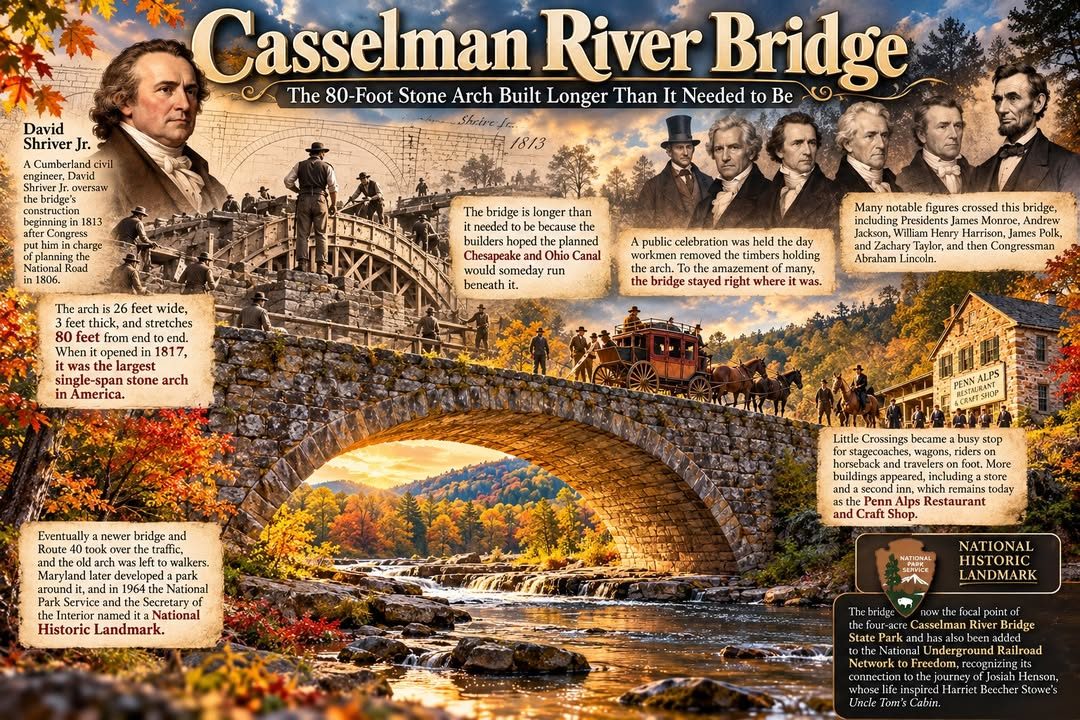
According to the Maryland Department of Natural Resources, the builders made the arch longer because they hoped the planned Chesapeake and Ohio Canal would eventually run beneath it. That canal never made it there, but the bridge they built has stood the test of time.
Construction began in 1813 under the supervision of David Shriver Jr., a well-known civil engineer from Cumberland who had been appointed to oversee the planning of the National Road in 1806. When the bridge opened in 1817, its 80-foot stone arch was the largest single-span stone arch in America.
And here’s another interesting part of the story: when construction was finished, the workers had to remove the wooden supports holding the massive stone arch in place. A public celebration was held for the occasion, and people gathered to watch. As the timbers came away, the crowd watched in amazement as the bridge remained standing.
Imagine being there that day, wondering whether the enormous stone structure would hold!
One of the most remarkable stories surrounding the bridge’s construction involves David Shriver Jr., the engineer who oversaw the project. According to local historical accounts, Shriver reportedly stood beneath the massive stone arch and personally helped remove a key piece of its supporting scaffolding to test whether the structure would hold. -- (this information was added thanks to Rachel Miller sharing it with us)
With the wooden supports removed, the bridge remained standing, demonstrating the strength of the stone arch and the craftsmanship behind its construction.
A Busy Stop Along the National Road
Long before modern highways and cars, the Casselman River Bridge was part of a much busier world. Known as Little Crossings, the area became an important stop for stagecoaches, horse riders, wagon drivers, and travelers making their way along the National Road.
The neighborhood eventually grew to include a store and a second inn. One historic building remains today as the Penn Alps Restaurant and Craft Shop, continuing a connection to the area’s long history of welcoming travelers.
And some of those travelers were pretty famous.
According to the Maryland Department of Natural Resources, presidents James Monroe, Andrew Jackson, William Henry Harrison, James Polk, and Zachary Taylor all crossed the bridge. Abraham Lincoln also passed over it while serving as a congressman.
Think about that the next time you visit. Those same stones once carried travelers who helped shape our nation’s history.
From a Major Roadway to a Historic Landmark
Eventually, a newer bridge and Route 40 took over the traffic, leaving the old stone arch behind for pedestrians to enjoy. Rather than disappearing into history, the bridge became the centerpiece of Casselman River Bridge State Park.
In 1964, the National Park Service and the Secretary of the Interior designated it a National Historic Landmark, recognizing its importance in American history and engineering.
But its story doesn’t end there.
The bridge and surrounding park have also received recognition through the National Park Service’s Underground Railroad Network to Freedom. Garrett County Government has highlighted the site’s connection to Josiah Henson, whose life inspired Harriet Beecher Stowe’s Uncle Tom’s Cabin.
Today, restoration efforts by the Maryland Department of Natural Resources and the Maryland Department of Transportation continue to help preserve this remarkable piece of our region’s past.
More Than Just a Bridge
For many of us, the Casselman River Bridge is simply a beautiful place to stop, take pictures, enjoy the river, or show visitors a little piece of Garrett County.
But behind those weathered stones is a story of ambitious engineering, early American transportation, famous travelers, and a community that grew around one of the most important roads of its time.
Built more than two centuries ago, the bridge continues to connect us with the people and events that came before us.
Today, the Casselman River Bridge is receiving some much-needed attention to help preserve it for future generations. Restoration efforts led by the Maryland Department of Natural Resources and the Maryland Department of Transportation are focused on repairing and stabilizing the historic structure, protecting its original stonework, and extending the life of this remarkable landmark.
The work is an important reminder that preserving history takes more than simply remembering the past. It takes time, care, and a commitment to protecting the places that tell our story. Although the bridge has stood for more than 200 years, continued maintenance and restoration are essential to ensuring it remains part of Garrett County's landscape for generations to come.
So, the next time you pass through Grantsville, take a moment to appreciate the Casselman River Bridge. What may look like an old stone arch is actually a remarkable piece of American history, and thanks to ongoing preservation efforts, its story is far from over.